


Mexico Issues Decrees to Fast-Track Investment and Streamline Trade Under Plan México
Share your love
 -Editorial
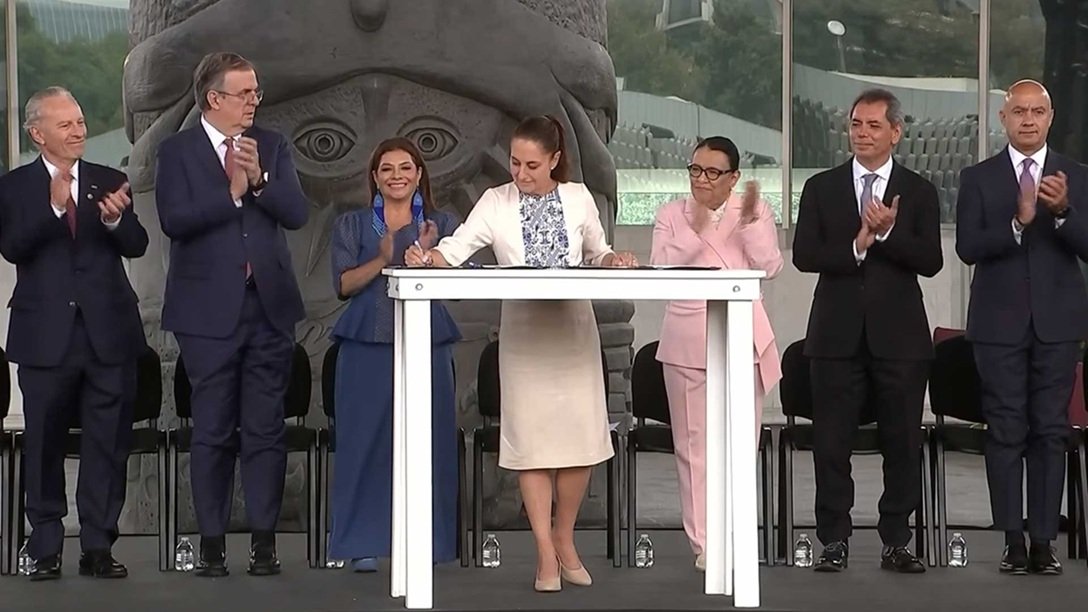
Mexican President Claudia Sheinbaum signed two decrees to accelerate investment approvals and streamline foreign trade as part of the federal government’s Plan México economic strategy, officials announced.
One decree establishes a “Single Window for Foreign Trade,” a centralized digital platform designed to consolidate 132 federal procedures into a single entry point. The system will connect the tax authority and customs agency, allowing companies to submit documentation once, monitor permit status, and receive notifications, with the goal of reducing administrative burdens and improving traceability in cross-border operations.
A second decree creates an expedited process for authorizing investment projects. Under the measure, qualifying projects, including those located in designated “development hubs,” exceeding 2 billion pesos in value, or tied to strategic sectors such as automotive, aerospace, pharmaceuticals, energy, and technology, may receive approval within a maximum of 30 days. Once approved, projects can begin execution immediately.
For all other private investments, the government set a maximum 90-day deadline for resolving federal permits. If authorities fail to issue a decision within that period, approval will be granted automatically under a “positive administrative silence” provision.
José Antonio Peña Merino, head of the Agency for Digital Transformation and Telecommunications, said the process will be managed through a unified digital platform and reviewed by an interagency committee composed of multiple federal ministries. The decree also establishes a Presidential Investment Office tasked with coordinating agencies, monitoring projects, and facilitating implementation.
Plan México, which covers the 2025–2030 period, aims to strengthen Mexico’s position as a global investment destination by attracting an estimated $277 billion in capital and increasing total investment to more than 25% of gross domestic product. The strategy prioritizes faster permitting, development of regional industrial hubs known as “Polos de Bienestar,” and import substitution policies designed to boost domestic production. Officials said the plan targets the creation of approximately 1.5 million jobs.
Altagracia Gómez Sierra, a coordinator of the initiative, said implementation will depend on coordination between the public and private sectors. She said businesses are expected to comply with regulations, reinvest capital, and contribute to job creation, while the government works to reduce barriers and provide clearer rules for investment.
Energy Secretary Luz Elena González Escobar said the strategy also includes measures to accelerate Mexico’s energy transition. The government aims to increase the share of renewable energy generation from 24% to at least 38%, while maintaining a mixed model in which 54% of electricity generation remains public, and 46% is open to private investment. Officials reported that projects under development and planning could add about 11,000 megawatts of clean energy capacity, contributing to a total renewable capacity of approximately 22,000 megawatts.
González Escobar said regulatory coordination among federal agencies has already reduced permitting times for energy generation projects by about 60%, cutting processes that previously took up to two and a half years. Authorities are also evaluating dozens of renewable energy projects under mixed public-private schemes and plan to launch additional calls for private investment, including energy storage initiatives. A digital permitting system is expected to further shorten approval timelines, in some cases to about one month for smaller-scale projects.
Finance Secretary Édgar Amador Zamora announced complementary fiscal measures aimed at strengthening legal certainty and improving administrative efficiency. The policies include limiting tax audits to one comprehensive review per fiscal year per taxpayer, applying uniform criteria, and upholding the principle of non-retroactivity. Additional provisions seek to accelerate tax refunds, prevent penalties in cases of institutional system failures, and enhance compliance with international agreements to avoid double taxation.
Plan México framework is built on coordinated actions among federal agencies, including the ministries of economy, energy, and finance, as well as development institutions. The strategy is intended to reduce bureaucratic obstacles, align regulatory processes across levels of government, and promote industrial policy focused on strategic sectors.