


Mexican President Meets with U.N. Human Rights Chief
Share your love
 -Editorial
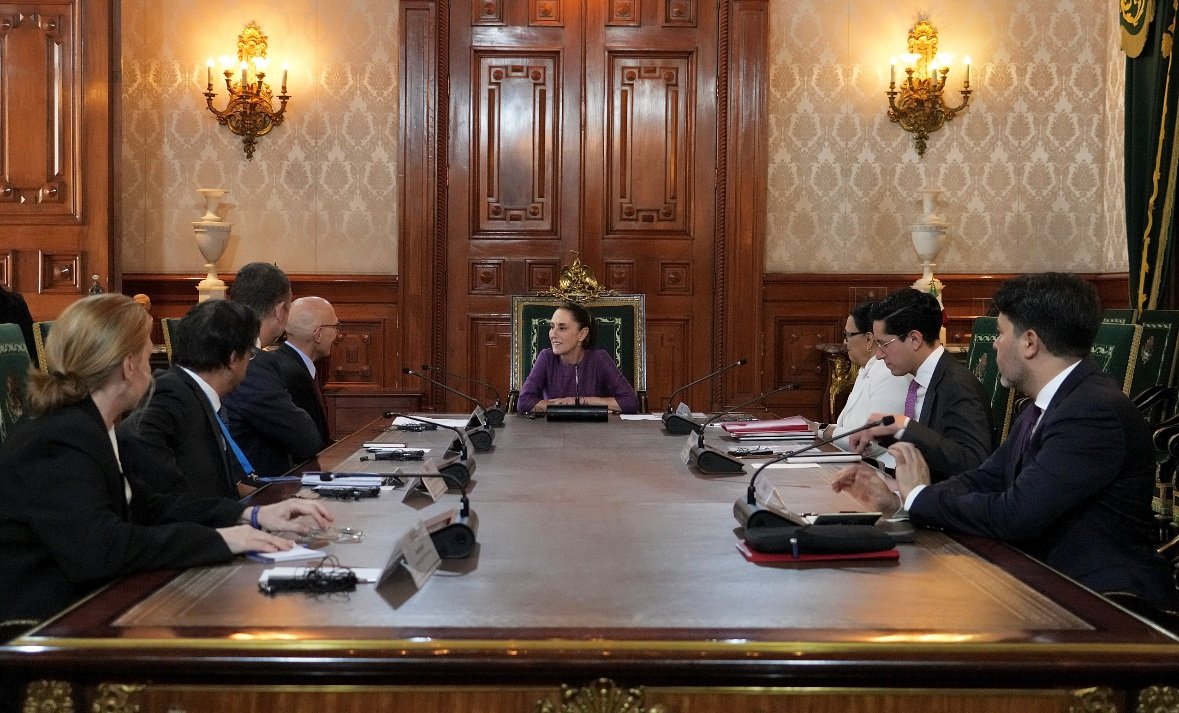
Mexico’s president, Claudia Sheinbaum, met with Volker Türk at the National Palace, where both sides discussed potential areas of collaboration on the promotion and protection of human rights, according to Mexican officials.
In a statement posted on social media, Sheinbaum described the meeting as constructive, saying the two parties held “a very good conversation” and agreed to pursue avenues of cooperation. She added that respect for and promotion of human rights in Mexico are shared objectives between her administration and the United Nations.
The meeting included senior officials from the Office of the United Nations High Commissioner for Human Rights, including Matthias Behnke, regional director for the Americas; Humberto Henderson, the office’s representative in Mexico; and Allegra Baiocchi, the United Nations resident coordinator in the country.
Mexican government officials present at the meeting included Interior Secretary Rosa Icela Rodríguez, Foreign Affairs Secretary Roberto Velasco, and Human Rights Undersecretary Félix Arturo Medina.
The Office of the United Nations High Commissioner for Human Rights (OHCHR) was established in 1993 following the World Conference on Human Rights in Vienna, which called for stronger global coordination on human rights issues. The office was created by the United Nations General Assembly to promote and protect human rights worldwide and to support the work of U.N. human rights mechanisms. The first high commissioner, José Ayala Lasso, took office later that year, marking the beginning of a more centralized and visible U.N. role in addressing human rights violations.
Since its founding, OHCHR has expanded its presence globally, working with governments, civil society, and international organizations to monitor conditions, provide technical assistance, and advocate for compliance with international human rights law. The office supports bodies such as the United Nations Human Rights Council and the system of independent experts and treaty committees that oversee the implementation of core human rights conventions. Over time, it has played a role in documenting abuses, advising on legal reforms and responding to crises, while continuing to face challenges related to political pressures, funding constraints and the complexity of enforcing international norms.
No specific agreements, policy measures, or timelines resulting from Wednesday’s meeting were immediately disclosed.