


U.S. Government Security, Economic Cooperation at Shield of the Americas Summit
Share your love
 -Editorial
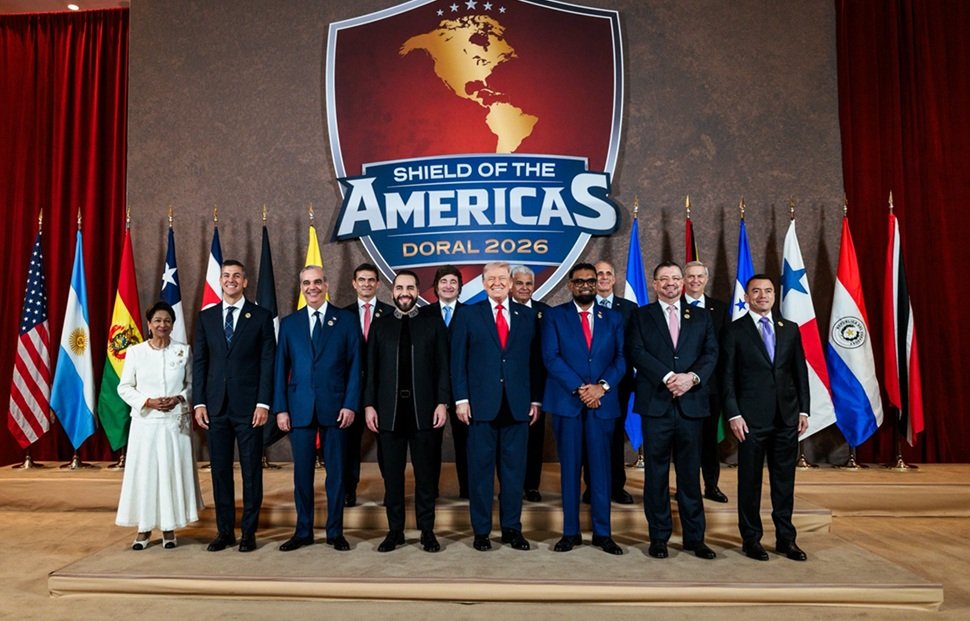
U.S. Secretary of State Marco Rubio and former Secretary of Homeland Security Kristi Noem with government leaders and officials from across the Western Hemisphere during a working lunch at the Shield of the Americas Summit, outlining a U.S.-led initiative aimed at strengthening regional security cooperation while expanding economic partnerships.
The meeting took place at Trump National Doral Miami and brought together representatives from multiple countries in the Americas to discuss coordinated efforts to combat transnational criminal organizations, address migration challenges, and increase collaboration on economic development.
Rubio opened the working lunch by welcoming participants and describing the summit as a key step toward building closer ties among governments in the region. He said the initiative places a strong emphasis on security cooperation but also seeks to broaden economic collaboration among partner nations.
“Obviously we start with a strong focus on security, but there is so much more here,” Rubio said. “There are many opportunities for us to work together.”
Rubio said the presence of several U.S. Cabinet officials reflected the administration’s intention to address both security and economic issues through the initiative. Representatives from agencies involved in trade, commerce, energy, and financial policy were among those participating in the summit discussions.
Rubio also said the administration wants the initiative to function as an ongoing partnership rather than a forum for occasional meetings.
“This is not going to be something where we meet one time and have conversations and then meet once a year and put out a paper,” Rubio said. “We want this to be an issue of action.”
He announced that Noem would serve as the administration’s special envoy for the initiative, coordinating with partner governments across the hemisphere to advance the program’s objectives.
Rubio said President Trump had planned to attend the working lunch but was traveling to Dover Air Force Base to receive the remains of six Americans killed in an operation targeting Iranian terrorism.
Noem said the Shield of the Americas initiative is designed to help countries in the region work together to defend their sovereignty, strengthen internal security, and promote economic growth.
“This is intended to be a group that works together to make sure that we’re each defending our own sovereignty, our own security and economic prosperity,” Noem said.
She said the framework also aims to strengthen partnerships among neighboring countries so they can confront common threats more effectively.
A central focus of the initiative, Noem said, is the fight against drug cartels and transnational criminal organizations that operate across national borders.
“These narcoterrorists are destroying our people and killing our children and our grandchildren,” Noem said, referring to organizations involved in drug trafficking and organized crime.
The U.S. government has designated several criminal cartels and transnational gangs as foreign terrorist organizations, a classification that allows federal authorities to deploy additional resources and legal tools against those groups.
Noem said regional cooperation will be essential to disrupting the networks used by criminal organizations to traffic drugs, weapons, and people across the hemisphere.
She also said the initiative seeks to counter external geopolitical influence in the region from actors outside the Western Hemisphere.
“Our objective is to ensure that adversaries who wish to change our way of life and our values remain outside our hemisphere,” she said.
During her remarks, Noem also discussed the administration’s immigration enforcement policies, saying the Department of Homeland Security has focused heavily on border security during the past year.
According to Noem, more than three million people have been deported or removed from the United States during that period as part of efforts to address public safety threats and illegal immigration.
She said stronger border enforcement has helped reduce migration pressures and allowed the government to place greater emphasis on economic partnerships and regional cooperation.
“Secure borders have changed everything for our country,” Noem said.
She added that the United States hopes to work with other governments in the region to strengthen their own border security systems and address migration challenges through coordinated policies.
Noem said the Department of Homeland Security has already engaged with several governments in Latin America on issues ranging from crime prevention to cybersecurity.
She cited meetings with El Salvador President Nayib Bukele, whose government has implemented sweeping security policies targeting criminal gangs, and Argentina President Javier Milei, whose administration has emphasized economic reform and fiscal restructuring.
Noem also referenced discussions with officials in Chile and Ecuador about cybersecurity cooperation and strategies to combat drug trafficking and organized crime.
In Chile, she said, U.S. officials worked with local authorities to deploy cybersecurity specialists to assist in strengthening digital security systems.
“These partnerships allow us to share expertise and build stronger defenses against threats that increasingly operate across borders,” Noem said.
She added that the administration intends to maintain direct communication with leaders participating in the initiative, saying she plans to share her personal contact information with counterparts in the region to facilitate ongoing collaboration.
The administration also released a presidential proclamation outlining the policy framework behind the initiative.
In the document, Trump said the United States has committed significant resources to dismantling criminal cartels and transnational criminal organizations operating in the Western Hemisphere.
“These international entities control territories and commerce, extort political and judicial systems, wield arms and field military capabilities, and use assassinations and terrorism to achieve their ends,” the proclamation states.
The document calls for increased coordination among allied countries to limit cartels’ access to territory, financing, and logistical networks.
The proclamation also encourages the United States and partner nations to expand military training and operational cooperation to strengthen regional security capabilities.
The proclamation referenced the Americas Counter Cartel Coalition, an initiative involving military leaders and representatives from 17 countries aimed at coordinating efforts to combat organized crime networks.
The coalition was established through cooperation among defense and security agencies in the region and focuses on improving intelligence sharing, joint operations, and training programs.
According to the proclamation, the coalition reflects a broader effort to use available resources and legal authorities to counter organized crime groups and reduce violence linked to drug trafficking.
Officials said the Shield of the Americas initiative is intended to serve as a long-term platform for cooperation among countries in the Western Hemisphere.
Beyond security coordination, the initiative also aims to support economic development by encouraging investment, strengthening trade relationships, and improving regional stability.
Noem said the initiative seeks to promote a Western Hemisphere that is safer, more sovereign and more prosperous.
She said the administration hopes the partnership will demonstrate how countries in the Americas can collaborate to address shared challenges while promoting democratic values and economic opportunity.