


Trump Signs Executive Order Designating Illicit Fentanyl as a Weapon of Mass Destruction
Share your love
 -Editorial
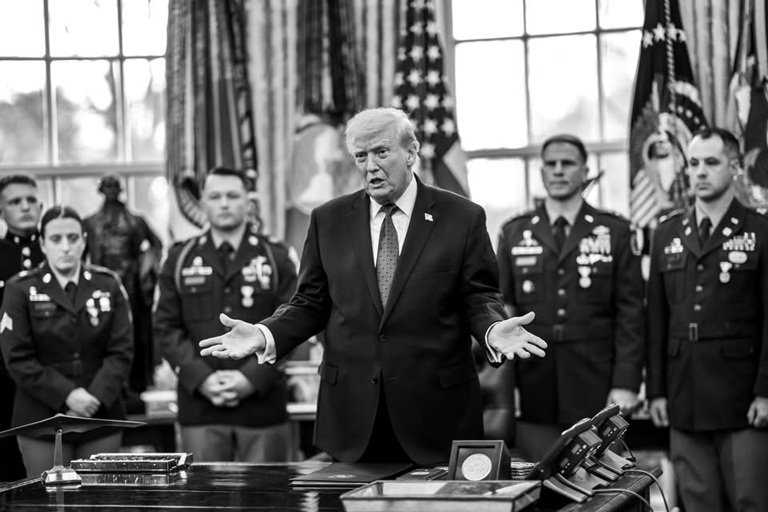
President Donald Trump on signed an Executive Order designating illicit fentanyl and its core precursor chemical as weapons of mass destruction (WMD), directing multiple federal agencies to take coordinated action against the manufacture, distribution, and trafficking of the synthetic opioid.
The order instructs the Department of Justice to pursue criminal charges, sentencing enhancements, and sentencing variances in cases involving illicit fentanyl. It also directs the Secretaries of State and the Treasury to take appropriate measures against assets and financial institutions tied to individuals or organizations involved in the production or distribution of fentanyl and its precursor chemicals.
Additionally, the Executive Order calls on the Department of War and the Department of Justice to determine whether enhanced national security resources should be deployed during emergencies involving fentanyl as a WMD. The order also directs the Department of War, in consultation with the Department of Homeland Security, to update chemical incident response protocols to include the fentanyl threat. Homeland Security is tasked with identifying fentanyl smuggling networks using WMD- and nonproliferation-related threat intelligence.
Administration officials characterized fentanyl as a highly potent synthetic opioid, noting that as little as two milligrams—equivalent to roughly 10–15 grains of table salt—can be lethal. They expressed concern that profits from fentanyl trafficking are used to fund criminal activity, violence, and, in some cases, international terrorist operations, and warned of the potential for fentanyl to be weaponized in concentrated attacks.
Trump has previously taken several measures against drug trafficking and cartels, including declaring a national emergency at the southern border, designating eight cartels as Foreign Terrorist Organizations, imposing tariffs on Mexico, Canada, and China in response to drug trafficking concerns, authorizing military strikes against narcotics operations, and signing the HALT Fentanyl Act, which permanently classifies fentanyl-related substances as Schedule I drugs under federal law.
The administration said the new Executive Order is intended to mobilize federal agencies in a coordinated effort to address fentanyl as a chemical threat, reduce its impact on American communities, and strengthen enforcement against criminal and transnational networks responsible for its distribution.