


Protesters Gather in El Centro as Part of Nationwide “No Kings” Demonstrations
Share your love
 -Editorial
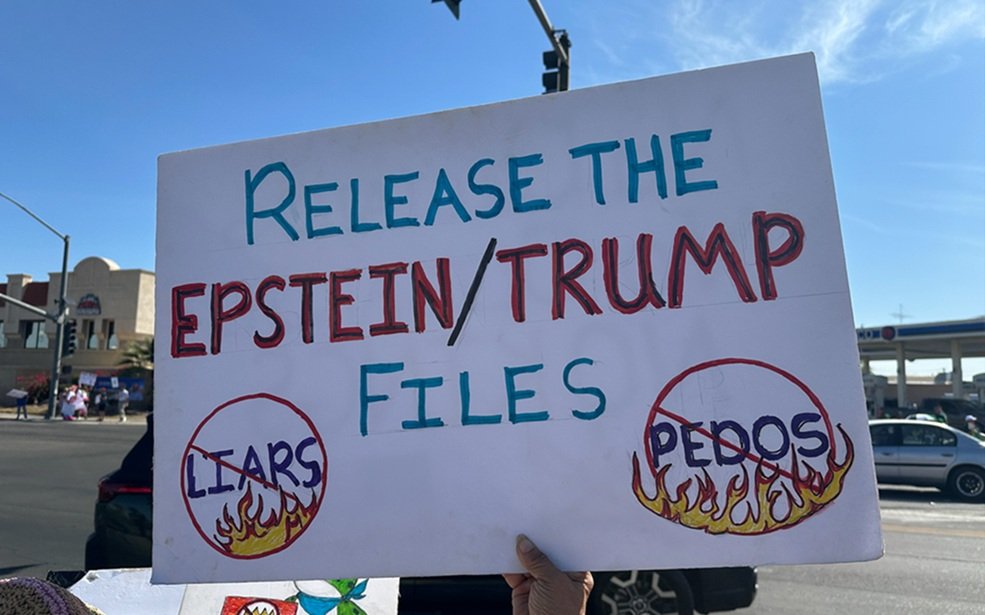
On March 28, demonstrators gathered at the intersection of Imperial Avenue and Main Street in El Centro, joining a growing wave of “No Kings” protests unfolding across the United States. From small border communities to major metropolitan centers, the coordinated demonstrations reflected a broader national moment—one defined by political tension, economic uncertainty, and an increasingly engaged electorate.
Participants in El Centro voiced opposition to Donald Trump and policies associated with his administration, which they say are negatively affecting families, employment, and the country overall. Similar sentiments echoed nationwide, where organizers framed “No Kings” as a call against what they describe as authoritarian tendencies and a defense of democratic institutions.
The El Centro gathering drew a cross-section of community members and advocacy groups, including representatives from Planned Parenthood, American Civil Liberties Union, and the local Democratic Party committee, among others. Protesters held signs, chanted, and engaged in peaceful demonstrations along one of the city’s busiest intersections. Organizers emphasized that the event aimed not only to express dissent, but also to encourage civic participation—an objective mirrored in cities across the country that saw similar turnout that same day.
Beyond California, prominent political figures amplified the message. During a rally in the Midwest, Tim Walz underscored the symbolic weight of the movement, stating that the United States “was founded on the idea that no one is above the law,” and warning against any political culture that elevates individuals over democratic principles. His remarks resonated with protesters nationwide, reinforcing the theme that leadership must remain accountable to the people.
The demonstration comes months before California’s June primary election, when candidates for offices including State Assembly and several local positions will be finalized for the November ballot. In Imperial County, recent electoral shifts have added a layer of complexity to the political landscape. The county voted for Trump in the last presidential election—marking the first time a Republican carried the region since George H. W. Bush in 1988. Additionally, the local State Assembly seat shifted to Republican control with the election of Jeff Gonzalez, the first Republican to hold the seat since Bonnie Garcia, who represented the district from 2002 to 2008.
El Centro resident Veronica Valenzuela expressed cautious optimism about the upcoming elections, citing sustained community engagement through protests. “I feel really good about it. As long as people keep coming out the way they’ve been coming out to protest, I think we have a really good chance of doing well in the upcoming elections,” she said, referencing both the June primary and November general election. Valenzuela pointed to rising grocery and gas prices, as well as concerns over immigration enforcement, as key issues impacting her family. “It’s just bad,” she added.
Former Imperial County Supervisor and El Centro Mayor Jack Terrazas also voiced optimism about Democratic prospects, pointing to what he described as a shift in voter sentiment. “In Imperial County, I feel very good. I think the people have woken up to a lot of the things that have been put in place, and they’re tired of it,” Terrazas said, suggesting that public dissatisfaction reflected in protests could translate into electoral gains.
Reflecting on previous election outcomes, Terrazas attributed Democratic losses in part to internal decisions. “I personally think it was the candidate who was chosen for the State Assembly. There wasn’t an opportunity for others to step in, and I think that upset people,” he said, noting that dissatisfaction extended beyond Imperial County into neighboring regions.
He added that issues such as health care access, public benefits, and broader national policies are shaping voter attitudes. “People liked the message at first, but now they’re seeing something different, and they don’t like it,” Terrazas said. “They don’t like changes to benefits or health care. Those things are waking people up.” Looking ahead, he anticipates shifting voter dynamics in both the June primary and November general election. “I think the numbers will change,” he said.
Statewide, the political stakes are equally high. California’s gubernatorial race is expected to be highly competitive as Gavin Newsom approaches the end of his two terms. Democrats are likely to face strong Republican challengers, including Steve Hilton and Chad Bianco. Some analysts suggest that, under California’s open primary system, the November runoff could—unusually—feature two Republican candidates.
As “No Kings” demonstrations ripple across the nation, the gathering in El Centro stands as a local reflection of a broader civic awakening. Whether driven by economic concerns, political polarization, or a renewed sense of democratic responsibility, these protests underscore a central question facing the country: how citizens choose to engage, respond, and ultimately shape the direction of American democracy in the months ahead.